If you have ever eaten at a Korean restaurant, watched a K-Drama, or explored Korean food online, you have probably encountered kimchi.
It may have appeared as a small red dish beside a bowl of rice. You may have seen someone add it to ramen, put it inside fried rice, or eat it alongside Korean barbecue.
But calling kimchi simply a “Korean side dish” misses something important.
Kimchi is also a story about how people preserved food before modern refrigeration, how Korean cuisine developed around changing seasons, how families passed down cooking knowledge, and how communities came together to prepare food for the months ahead.
In 2013, UNESCO inscribed Kimjang, the making and sharing of kimchi in the Republic of Korea, on the Representative List of the Intangible Cultural Heritage of Humanity. The focus was not simply on the finished food, but on the social practice surrounding its preparation and sharing.
To understand kimchi, then, you have to look beyond the jar.
What Exactly Is Kimchi?
Kimchi is a Korean fermented vegetable dish made with vegetables and various seasonings.
The best-known version is baechu kimchi (배추김치), made primarily with napa cabbage. But cabbage is only one possibility.
Kimchi can also be made with:
- Radish
- Cucumber
- Green onion
- Young summer radish
- Leafy vegetables
- Other seasonal ingredients
The seasonings vary as well. Depending on the recipe, they may include Korean red pepper flakes (gochugaru), garlic, ginger, salted seafood, fish sauce, or other ingredients.
This is one reason it is difficult to describe kimchi as having a single flavor.
Some kimchi is spicy and intensely fermented. Some is relatively mild. Some is crunchy and refreshing, while others develop a deeper, more sour flavor as fermentation progresses.
There is no single “kimchi taste.”
There is a world of kimchi.
Why Did Koreans Start Making Kimchi?
One of the most important stories behind kimchi is preservation.
For much of Korean history, people did not have modern refrigerators or year-round access to fresh vegetables. Preserving vegetables was therefore an important part of preparing for winter.
Salting and fermentation provided a way to keep vegetables for longer periods.
Over time, Korean people developed increasingly varied methods of seasoning and fermenting vegetables. The result was not one fixed recipe, but a large family of foods that changed according to region, climate, ingredients, household traditions, and season.
This history helps explain something that can seem surprising to visitors today:
Kimchi was not originally created to become an internationally famous Korean food.
It developed from a practical need to preserve food.
The cultural significance came later through generations of cooking, sharing, adapting, and eating it.
Kimchi Is About Fermentation, Not Just Spice
People encountering kimchi for the first time often focus on its red color and spicy flavor.
But one of the most interesting things about kimchi is actually fermentation.
Fermentation changes the flavor, aroma, texture, and acidity of the vegetables over time.
Freshly prepared kimchi can taste relatively crisp and bright. As it ferments, the flavor can become more complex and sour.
This is why Koreans may use kimchi differently depending on how old it is.
Fresh kimchi can be eaten directly with a meal.
More mature kimchi can become an ingredient in dishes such as:
- Kimchi jjigae
- Kimchi fried rice
- Kimchi pancakes
- Kimchi dumplings
- Kimchi stew with pork
In other words, kimchi does not necessarily have a single moment when it is “finished.”
Its character changes with time.
That makes fermentation an important part of the experience of eating kimchi.
Kimchi and the Korean Table
There is another reason kimchi is culturally important: where it sits on the Korean table.
A traditional Korean meal commonly includes rice, soup or stew, and a variety of side dishes known as banchan (반찬).
Kimchi is one of those side dishes, but it has a particularly familiar place in everyday Korean meals.
You might eat a small amount of kimchi with rice, grilled meat, soup, noodles, or other dishes.
This means kimchi often works less like a main course and more like a flavor that connects the rest of the meal.
Its sourness, saltiness, spice, aroma, and crunch can provide contrast to milder foods.
For someone unfamiliar with Korean food, this is an important distinction.
You do not necessarily need to eat an entire serving of kimchi by itself.
Try a small piece with rice or another dish and notice how the flavors change when they are eaten together.
Kimchi Is Not One Recipe
One of the easiest mistakes for an international visitor is to think that kimchi always means spicy red cabbage.
Baechu kimchi may be the most internationally recognizable variety, but Korean kimchi culture is much broader.
Kkakdugi (깍두기), for example, uses diced radish and is known for its firm, crunchy texture.
Oi-sobagi (오이소박이) is made with cucumber and is particularly associated with warmer seasons.
Nabak-kimchi (나박김치) is a watery style made with sliced vegetables and a flavorful broth.
There are also white varieties such as baek-kimchi (백김치), which do not rely on red pepper for their appearance or flavor.
Recipes also differ between households and regions.
That means asking, “What does kimchi taste like?” is a little like asking, “What does bread taste like?”
The answer depends on what kind you are eating.
The Cultural Meaning of Kimjang
Perhaps the most important cultural connection is kimjang (김장).
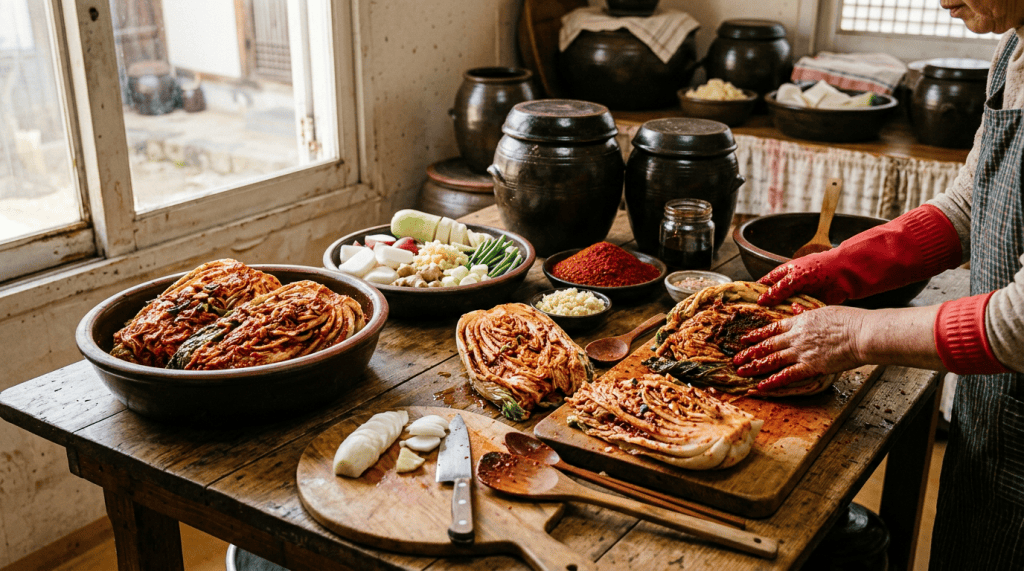
Kimjang refers to the traditional practice of preparing large quantities of kimchi for the coming winter and sharing the work and food within families and communities.
The significance of kimjang goes beyond cooking.
Preparing large quantities of kimchi can require considerable amounts of vegetables, seasoning, preparation, and labor. Historically, this created opportunities for family members, neighbors, and communities to work together.
UNESCO’s recognition of kimjang specifically emphasizes this communal dimension.
The tradition involves making and sharing kimchi, passing down knowledge, cooperating with others, and strengthening social relationships.
This is why saying that “kimchi is part of Korean culture” is more than a marketing phrase.
The process surrounding kimchi has cultural meaning.
From Generation to Generation
Food traditions are often preserved not through written recipes alone, but through people.
A family may have its own preferred balance of ingredients, preparation methods, or fermentation preferences.
A younger family member might learn by watching an older relative prepare kimchi.
The recipe can change over time, too.
This is important because traditional food should not be imagined as something frozen in the past.
Korean food continues to evolve.
Modern households may buy packaged kimchi from supermarkets instead of making it at home. Some people make kimchi regularly, while others rarely or never prepare it themselves.
Restaurants, food companies, and home cooks also experiment with new ingredients and recipes.
So there is a difference between the cultural tradition of kimchi-making and the way every individual Korean eats today.
Not every Korean household makes kimchi.
But kimchi remains an important symbol and component of Korean food culture.
Kimchi in Contemporary Korea
Kimchi has also changed with modern life.
Korean supermarkets now sell many varieties of commercially produced kimchi in different sizes and packaging.
Convenience stores sell small portions.
Restaurants may provide different types depending on the menu.
And kimchi has moved far beyond the traditional Korean meal.
It can appear in burgers, sandwiches, pizza, pasta, fried rice, tacos, and fusion dishes.
Some of these combinations may surprise traditionalists, but they also demonstrate how food changes when it travels.
When kimchi enters another country’s cuisine, it does not necessarily stop being Korean.
Instead, it becomes part of a new culinary conversation.
That is one reason kimchi is such an interesting example of how Korean culture is becoming increasingly international.
Why Does Kimchi Smell So Strong?
This is a completely reasonable question for someone trying kimchi for the first time.
Kimchi has a distinctive aroma because of its ingredients and fermentation.
Garlic, fermented seafood, spices, vegetables, and fermentation all contribute to its characteristic smell.
For someone accustomed to mild pickled vegetables, the first encounter can be intense.
The important thing is not to assume that a strong smell means the food has gone bad.
Kimchi is a fermented food, so its aroma is naturally different from that of fresh vegetables.
That said, proper storage still matters, and kimchi should be handled according to the storage instructions for the particular product.
How Should a First-Time Visitor Eat Kimchi?
You do not have to start by eating a large amount.
A simple way to experience kimchi is to try it in stages.
1. Try a small piece by itself
Notice the texture first.
Is it crunchy? Soft? Juicy?
Then pay attention to the flavor.
2. Eat it with plain rice
This is a useful introduction because rice provides a neutral background for the kimchi.
3. Try it with Korean barbecue
The acidity and spice can provide a strong contrast to rich grilled meat.
4. Try aged kimchi in a cooked dish
Kimchi jjigae is an excellent example of how fermentation changes its role.
The kimchi becomes part of a warm, savory dish rather than remaining a cold side dish.
5. Try more than one variety
If you dislike the first kimchi you taste, do not conclude that you dislike kimchi.
A crunchy radish kimchi can be very different from fermented napa cabbage kimchi.
Kimchi Is a Good Way to Understand Korea
Kimchi tells several Korean stories at once.
It tells the story of seasonality, because vegetables and preparation methods have traditionally been connected to the seasons.
It tells the story of preservation, because fermentation helped people make food last longer.
It tells the story of family, because recipes and techniques have been passed between generations.
It tells the story of community, especially through kimjang.
And it tells the story of change, because kimchi continues to appear in new forms in contemporary Korean food.
That is why kimchi is more interesting than simply calling it a “famous Korean food.”
It is a small window into how food, environment, family, technology, and society can become connected.
More Than a Side Dish
For international visitors, Korean food can initially seem like a collection of unfamiliar dishes: bibimbap, bulgogi, tteokbokki, samgyeopsal, japchae, and kimchi.
But once you understand the cultural role of kimchi, the Korean table begins to make more sense.
You start to notice the importance of fermentation.
You notice the variety of side dishes.
You notice how flavors are combined rather than isolated.
And you begin to see why a small dish sitting quietly beside your rice can have such a large cultural presence.
Kimchi is food, of course.
But it is also a record of adaptation, preservation, shared knowledge, and changing Korean life.
The next time you see a small red dish on a Korean table, try looking at it differently.
Don’t just ask, “Is it spicy?”
Ask what it can tell you about Korea.


Leave a comment