Imagine entering a café directly from an uphill street, then walking across a level floor to a window overlooking roofs below. You have barely climbed inside the building, yet the view feels several stories high. On a steep site, the ground has done some of the climbing for you.
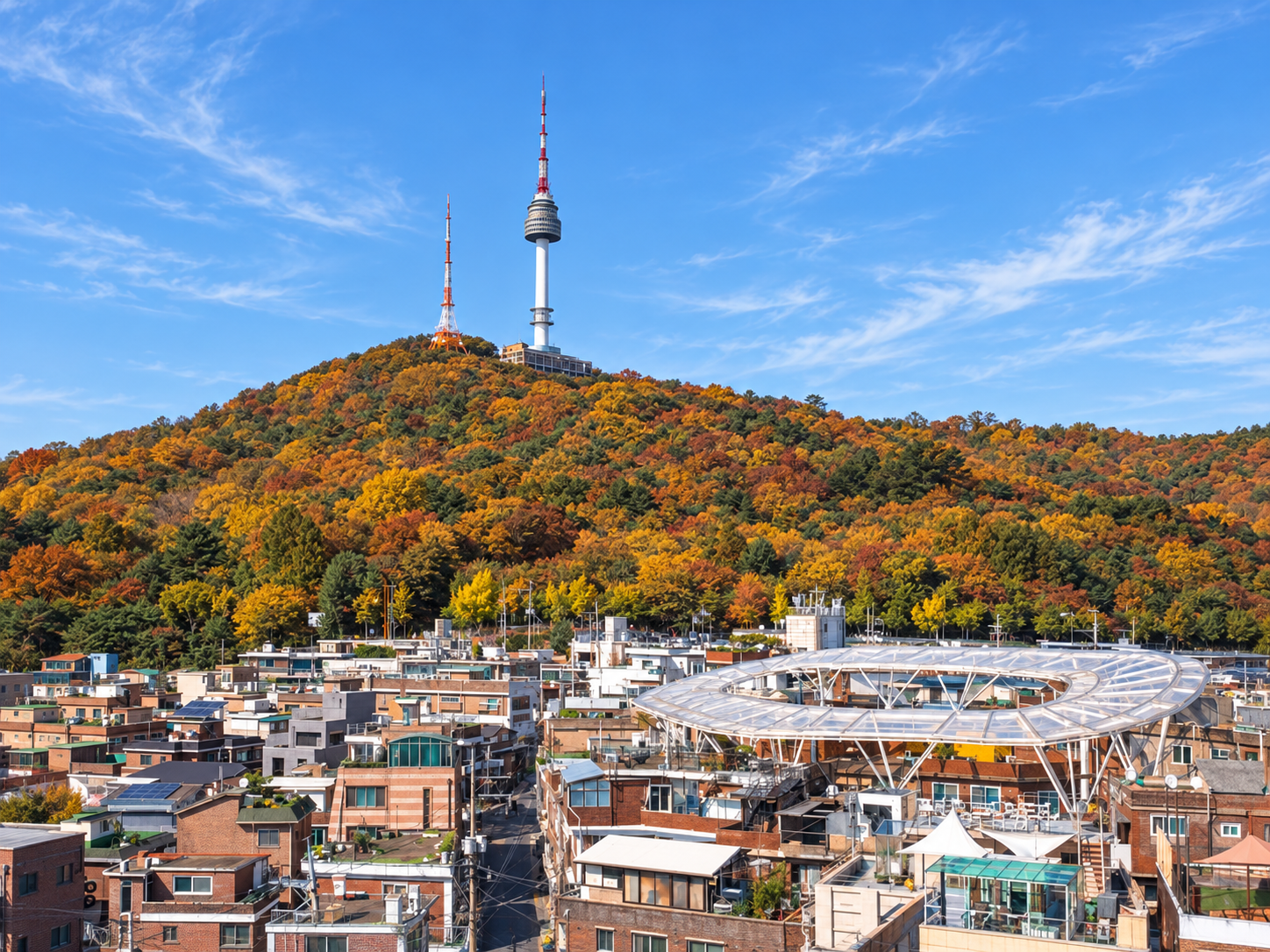
Haebangchon and Itaewon rooftop views become more interesting when you understand this relationship between terrain and architecture. Around Namsan’s southern slopes, the experience depends on the hillside, the building, and the direction you face—not simply the number beside the elevator button.
Visitor information checked October 21, 2026, Korea time. Confirm current opening and rooftop access before visiting.
How can an entrance-level room have an elevated view?
Architects explain this through a section: an imaginary vertical slice through a building and its site. Floors usually remain horizontal while the surrounding ground slopes. An entrance meeting the uphill street can therefore share a level with windows high above the downhill ground.
Consider an illustrative building with three-meter floor intervals. If the ground falls six to nine meters across its footprint, the entrance-level floor could sit two to three story-heights above the lower ground. From that side, it may resemble a third- or fourth-floor vantage point. These are hypothetical dimensions, not measurements of a featured venue or a rule for the neighborhood.
| Position | Relationship to the ground | Possible experience |
|---|---|---|
| Uphill entrance | Floor meets the higher street | Walk-in access |
| Downhill window on the same floor | Ground has dropped below | Elevated outlook without climbing inside |
| Roof above | Building height adds to site elevation | A wider view if neighboring roofs remain lower |
Actual floor labels depend on the building. A change in the ground outside does not necessarily mean split-level floors inside.
Why the hillside makes rooftops valuable
Elevation starts before you enter
A modest building on an elevated plot can overlook buildings farther downhill. Its roof gains height from both the structure and the terrain. However, a taller neighboring building can still block the view: slope creates an opportunity, not a guaranteed panorama.
The view has several layers
Nearby roofs provide a foreground, streets and buildings form a middle distance, and the skyline lies beyond. This layered outlook feels different from a tower observatory because the neighborhood remains close enough to read. Turning uphill may bring Namsan into view; turning downhill may reveal the wider city. The two views are not interchangeable.
Rooftops offer a change of spatial experience
Moving from a confined stairway or narrow street to an open terrace can make the sky feel unexpectedly expansive. Seating, lighting, and food service turn that contrast into somewhere to spend an evening. This is an architectural explanation of the appeal, rather than proof that terrain alone created the area’s rooftop businesses.
From residential hillside to rooftop destination
Haebangchon developed as a place of settlement after liberation and during the upheaval surrounding the Korean War. Its steep streets were part of everyday residential life long before they became visitor attractions. Official tourism accounts document that history alongside the later growth of cafés and restaurants. [1]
The neighborhood sits beside the wider Itaewon area; the names should not be treated as identical boundaries. Gyeongnidan-gil, around Hoenamu-ro in Itaewon-dong, offers another setting for exploring the slopes. [2] Together, these adjoining areas show how hospitality businesses can turn existing elevation into an experience while remaining embedded in residential streets.
Where to experience the views

Cliff Seoul: rooftops in the foreground, skyline beyond
Visit Seoul describes Cliff Seoul’s rooftop outlook over nearby homes toward the larger skyline, with indoor windows offering another viewing option. Its address is in Huam-dong, although it features in Haebangchon walking itineraries. [2] Use it to compare an enclosed window view with an outdoor terrace, without assuming either is accessible without stairs.
Visit details: 29-17 Duteopbawi-ro 38-gil, Yongsan-gu. The October 2026 tourism guide lists daily hours of 12:00–22:00. Confirm terrace availability and seating arrangements before going. Official guide.
Namsan Memories: looking toward the mountain
Google Maps — Namsan Memories / Namsan Gieok
This Japanese restaurant is listed with a rooftop view toward Namsan Tower. [3] It offers a useful reminder to choose a venue by view direction, not just the word “rooftop.” A mountain-facing terrace and a city-facing terrace can deliver very different evenings.
Visit details: Second floor, 6 Sowol-ro 20-gil, Yongsan-gu. Visit Seoul lists evening service Wednesday–Sunday and Monday–Tuesday closure. Check the linked operator account for reservations and rooftop access. The venue’s advertised view does not verify the hypothetical building section explained above. Official visitor information.
Planning a hillside walk near Itaewon
Noksapyeong Station, Line 6, Exit 2 is a useful starting point for Haebangchon. [1] Choose one rooftop destination rather than assuming every nearby pin is an easy walk: distance on a map says little about the climb. For an architecture-focused outing, allow roughly two to three hours for walking and a meal or drink; this is a planning estimate.
Arrive before sunset to see the terrain clearly, then stay for changing light if conditions allow. Ask about a taxi drop-off near the venue if steep approaches are difficult. Confirm the complete access route, including the final rooftop stairs, and keep residential entrances clear. Photograph the city without pointing cameras into neighboring homes.
Frequently asked questions
Does “first floor” mean a street-level view on every side?
No. On a slope, one floor can meet the uphill street while overlooking lower ground on the opposite side. The building’s labels alone do not describe that relationship.
Does every rooftop have a sunset or Namsan Tower view?
No. Orientation, neighboring buildings, seating position, and weather matter. Ask about the specific view you want and whether the terrace will be open.
Are hillside rooftop venues step-free?
Not necessarily. Even a walk-in entrance may lead to stairs farther inside. Check access from the street to your actual table, rather than asking only whether the building has an elevator.
On these hills, look at the street, then the floor, then the horizon. The surprising distance between them explains why a small building can offer such a memorable view of Seoul.
More to Read
- Itaewon District Guide :
Itaewon & Yongsan Guide: Best Things to Do in Seoul - Seongsu Brick Architecture Guide :
Seongsu’s Red-Brick Factory Cafés: An Architecture Walk
Sources
The section example is a general geometric illustration. No venue drawings, surveyed ground levels, or first-hand visit are claimed; the explanation of rooftop appeal is editorial architectural interpretation.
- Visit Seoul — Haebangchon, updated June 17, 2026. Neighborhood history, terrain, and station access.
- Visit Seoul — An Early Autumn Night Walk from Haebangchon to Gyeongnidan, updated October 13, 2026. Cliff Seoul, its location and visitor information, and Gyeongnidan-gil geography.
- Visit Seoul — Namsan Memories, updated May 21, 2026. Address, rooftop view, and operating days.
Leave a Reply