A neighborhood drama makes an ordinary journey interesting. Walking home can become a conversation; buying groceries can put two characters in the same place again. The setting helps relationships accumulate through repeated encounters.
To understand Korean neighborhood life in K-dramas, pay attention to those routes as well as the people. Ask what connects a home, a shop, and a meeting place—and where someone can choose to be alone.
Two dramas, two different neighborhood worlds
The National Institute of Korean Language’s dictionary translates dongne (동네) as neighborhood and golmok (골목) as alley, a narrow passage between houses. These are useful words for describing a setting, but neither word promises an unusually close community.
Reply 1988 follows five neighboring families in Ssangmun-dong, Seoul, with a story set in 1988. The date matters: its neighborhood belongs to a deliberately historical story, not a present-day survey of Korean residents.
Hometown Cha-Cha-Cha begins with a city dentist opening a practice in a seaside village. Its premise offers a different comparison: someone arriving in a community where other people already have connections.
While watching either, notice how a newcomer or younger character enters a conversation. Who introduces them? Can they leave comfortably? Those questions help you distinguish welcome, obligation, and interference without assuming every friendly exchange means the same thing.
Rather than asking which series shows the “real Korea,” compare their particular settings. Time period, location, household circumstances, generation, and individual preferences all belong in the picture.

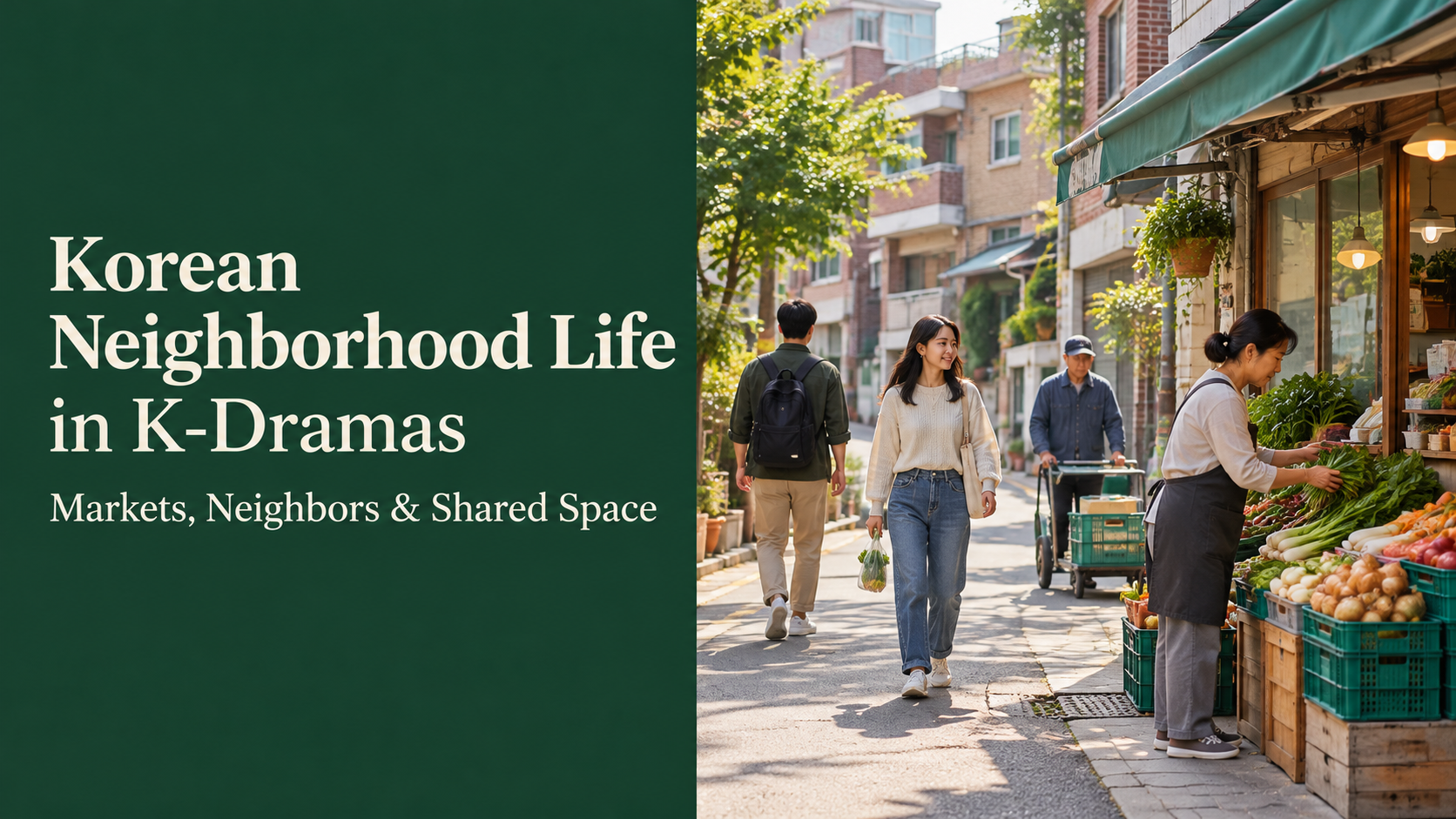
A market belongs to a wider everyday route
For a real urban example, Seoul Metropolitan Government’s Mangwon Market feature describes a market surrounded by low-rise multifamily residences, with cafes and restaurants nearby along Mangnidan-gil. Its August 2020 account provides a concrete example of shopping and housing occupying the same neighborhood.
That spatial relationship is useful when watching fiction. A market scene need not be only a pause for appealing food. Ask whether it connects a character’s workplace, home, errands, or social life. Repeated visits can give a writer plausible opportunities for people to meet.
Separate the transaction from the relationship. A helpful vendor may be serving a customer; a familiar greeting may suggest repeated contact. Neither detail alone establishes friendship, credit arrangements, or a family-like bond.
If you visit a market, let your own experience begin with a small purchase or a question about what is being sold. Check current shop information, ask before photographing people, and leave room for shoppers to pass. An everyday shopping trip does not need to reproduce a television scene.

Shared space still has boundaries
A lane or public bench can bring characters together while leaving their expectations unresolved. When watching, ask who initiates contact, who needs something, and whether the other person has a genuine chance to decline.
Try comparing an invited visit with an unannounced arrival. The same helpful gesture can feel different when someone has asked for it. Treat the characters’ responses as part of the story rather than turning a warm scene into a rule that neighbors should welcome any intrusion.
Real visitor guidance makes the distinction especially clear. Visit Seoul’s Bukchon page emphasizes that people live there and asks visitors to keep noise down and avoid photographing home interiors, even through open doors.
Bukchon is a specific residential destination with its own visitor restrictions. Consult the current official guidance and posted notices before going; do not transfer its access rules to every Korean neighborhood.
Those boundaries can deepen your viewing, too. Notice what happens at a doorway, who receives an invitation, and which conversations move somewhere more private. Closeness becomes more interesting when people still have choices.

Make a neighborhood map while you watch
Choose one episode and sketch three places: a home, a business, and somewhere people pause. Add arrows for the journeys between them. Record who meets by chance, who makes an appointment, and who takes the time to help.
Then ask whose work keeps those places functioning. A welcoming shop also requires someone to open it, serve customers, and clean up. Looking for that effort makes a neighborhood more than an attractive backdrop.
For a real visit, choose a manageable public route and support businesses on their own terms. Keep residential entrances clear and accept that residents may simply want to finish their day.
Viewing note: Streaming catalogs and subtitle options vary by country, title, and account. Check your local licensed service before subscribing.
FAQ
What do dongne and golmok mean?
Dongne (동네) means neighborhood. Golmok (골목) means alley, a narrow passage between houses. The words describe places; they do not guarantee that everyone nearby has a close relationship.
Does Reply 1988 show how Korean neighborhoods work today?
Its story is set in 1988 and follows five neighboring families in Seoul’s Ssangmun-dong. Use that period as part of your interpretation. A historical ensemble drama cannot establish current relationships throughout Korea.
Is Mangwon Market a filming location for either drama?
This article does not make that claim. Mangwon is used as an official, documented example of a market located among homes and nearby businesses. Its role here is to explain spatial context, not to offer a filming-site itinerary.
Can I photograph homes when visiting a residential neighborhood?
An open door is not an invitation to photograph inside. Visit Seoul’s Bukchon guidance explicitly asks visitors to avoid photographing home interiors. Ask before photographing people, respect private spaces, and follow the specific destination’s current notices.
How can I notice neighborhood culture without understanding every line?
Map where the characters go and compare repeated encounters. Note who initiates contact, who is working, and whether an invitation is offered. You can observe those choices while using subtitles, without treating one scene as a universal rule.
Sources & photo credits
Article references
Research checked October 23, 2026 (Asia/Seoul). Viewing questions and the mapping exercise are editorial interpretation; source-backed descriptions are identified below.
- NIKL Korean-English Learners’ Dictionary — 동네. Neighborhood meaning; Korean definition describes an area of multiple homes. Only the definition is used, not every illustrative sentence.
- NIKL Korean-English Learners’ Dictionary — 골목. Alley meaning and narrow passage between houses.
- Visit Seoul — 30 Years Ago, Seoul and Reply 1988. Published February 11, 2016; edited August 25, 2023. Supports the story’s 1988 setting and five neighboring families in Ssangmun-dong. Older itinerary details, school-model speculation, business hours, and transport directions are not used as current travel advice.
- Netflix — Hometown Cha-Cha-Cha. Official premise of a city dentist opening a village practice. No exact dialogue, later plot outcome, or named filming location is claimed.
- Seoul Metropolitan Government — Mangwon Market & Mangnidan-gil Street. August 11, 2020 feature describing low-rise multifamily housing around the market and nearby cafes/restaurants. Used explicitly as a dated example, without current-price, merchant, opening-hour, or unchanged-layout guarantees.
- Visit Seoul — Bukchon Hanok Village. Edited September 11, 2026. Residential character, quiet behavior, home-interior photography guidance, and existence of destination-specific visitor restrictions. Readers are directed to current official guidance and posted notices; this article does not reproduce a restricted-zone boundary, visiting timetable, fine, or legal interpretation.
- Netflix Help — How many countries and regions is Netflix available in?. Country-dependent, changing catalogs.
- Netflix Help — Why subtitles or audio isn’t available in a specific language. Language options depend on location, profile, title, device, and licensing.
Retrieval note: a separate Visit Seoul Mangwon shopping-page URL returned 404. The accessible Seoul Metropolitan Government feature provides the market context used here. Shortened dictionary URLs did not resolve in the research tool; the full indexed official entry URLs above were retrieved successfully. Required source coverage is complete.
Photo credits
- Gyedong-gil in Seoul’s Bukchon neighborhood. Photo: Basile Morin / Gyedong-gil street with climbing plants at golden hour in Seoul South Korea.jpg (Wikimedia Commons) (CC BY-SA 4.0).
- Mangwon Market in Seoul. Photo: Enamoradadecorea / Mercado Mangwon en Seúl.jpg (Wikimedia Commons) (CC0 1.0).
- People using shared outdoor space at Seoul Forest Park. Photo: WANGYIFAN2024 / People are enjoying a spring outing at Seoul Forest Park.jpg (Wikimedia Commons) (CC0 1.0).
Leave a Reply