Hanok Cafés and Stays in Bukchon & Seochon: A Seoul Guide
You do not have to book a night in a traditional Korean house to experience one. In Seoul’s Bukchon and Seochon neighborhoods, you can explore a historic residence, visit an exhibition in a former home, or sit beneath exposed timber beams with a coffee. An overnight stay offers something different: time to notice how a small garden, a doorway, and the changing daylight shape a room.
This guide to hanok cafés and stays in Bukchon and Seochon helps you choose an experience that fits your trip—and understand the architecture while you are there. The most interesting question is not simply how old a house looks. It is how the building has adapted to new ways of living.
Research checked: October 19, 2026. Opening arrangements, exhibitions, and accommodation details can change; use the official links before visiting or booking.
Where can you experience a hanok without staying overnight?
For a first visit, start with Baek In-je’s House in Bukchon to understand historic domestic architecture. Choose Bae Ryeom’s House for a public hanok with changing cultural programming, or Café Haven in Seochon for a relaxed introduction over coffee. Seochon Lounge connects hanok spaces with contemporary design and exhibitions.
If you want a private overnight experience, research Nuwa or THE CHAE: Gallery in Seochon. These are accommodation examples, not places to enter casually during a neighborhood walk.
| What you want | A useful starting point | What to check |
|---|---|---|
| Historic architecture | Baek In-je’s House, Bukchon | Interior access and guided tours |
| Art in a domestic setting | Bae Ryeom’s House, Bukchon | Current exhibition and program schedule |
| Coffee inside a hanok | Café Haven, Seochon | Opening day and seating availability |
| Contemporary Korean living and design | Seochon Lounge | Current exhibition and opening arrangements |
| An intimate hanok stay | Nuwa, Seochon | Current room details, bath use, and price |
| Art combined with accommodation | THE CHAE: Gallery, Seochon | Exact property, group capacity, and current amenities |
Bukchon and Seochon: two neighborhoods, many kinds of hanok
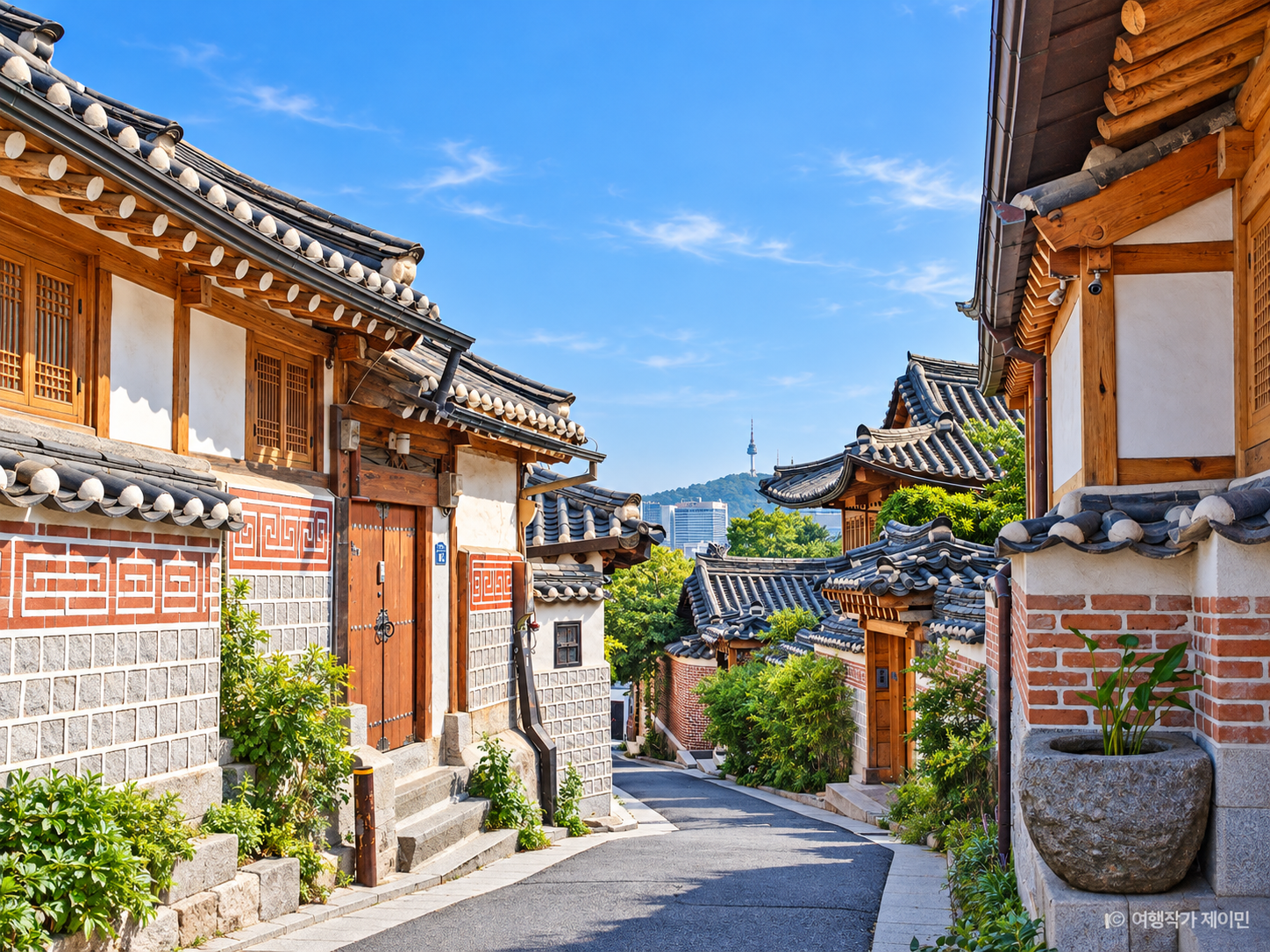
Bukchon lies between Gyeongbokgung and Changdeokgung palaces. Its tiled roofs make an immediately recognizable cityscape, but the houses should not all be described as untouched, centuries-old buildings. Seoul’s official hanok history explains that substantial groups of the neighborhood’s compact urban hanok took shape in the 1930s, when larger plots were subdivided for housing.
Modernization was already part of that story. Glass doors and other newer materials helped adapt traditional forms to denser urban life. A contemporary hanok café is therefore part of a longer conversation about change, even though each renovation makes different choices. [1]
Seochon lies west of Gyeongbokgung. Here, urban hanok sit alongside houses and apartment buildings from other periods, with markets, cafés, galleries, and everyday neighborhood businesses between them. Its history includes royal and influential households as well as writers and artists; reducing it to a timeless “commoners’ village” misses that complexity. [2]
For this itinerary, choose Bukchon for the historic-house and public-art pairing, and Seochon for the café, design-space, and accommodation pairing. This is a way to organize your visit, not a fixed division between the neighborhoods.
How to read a hanok before you step inside
A hanok is a traditional Korean house, but there is no single layout shared by every example. Region, household resources, climate, and later alterations all matter. Seoul’s architectural guide describes a timber framework and several different arrangements of rooms and halls. [3]
Four features give you an easy starting point:
- Timber frame: Look for upright posts and the beams above them. In a renovated café, the ceiling may reveal more of the house’s structure than its shopfront does.
- Madang, or courtyard: Notice whether rooms face inward toward an open space. Ask how this changes the view from a chair compared with a room facing a busy street.
- Maru, or raised wooden floor: Traditionally, this wooden-floored area formed a different kind of living space from the heated rooms. Look at the level changes and transitions between indoors and outdoors.
- Ondol, or underfloor heating: Warm floors helped shape floor-based domestic life. A modern hanok stay may use contemporary heating and raised beds; confirm its actual setup instead of expecting a historical reconstruction.
During a visit, follow the route from gate to courtyard to room. Then ask what has changed: a glass enclosure, new bathroom, café counter, or exhibition lighting. These details reveal how a house is being used today.
Hanok houses, cafés, and galleries you can visit by day
Baek In-je’s House: a historic hanok already embracing change
Google Maps — Baek In-je’s House
Built in 1913, this Bukchon house combines a hanok form with glass windows, red brick, and Japanese architectural influences. Its connecting hallway allows movement between the principal residential sections without going outside. These are early twentieth-century changes, not a recent café conversion. [4]
Look at that circulation pattern alongside the courtyard-facing arrangements you encounter elsewhere. How does being able to move indoors change the experience of a house?
Plan your visit: Admission is free. The museum lists 09:00–18:00 opening and normally closes Mondays, with holiday exceptions. Self-guided admission does not include entering the rooms; check its tour guidance for additional access.
Getting there: Anguk Station, Line 3, Exit 2. Address: 16 Bukchon-ro 7-gil.
Official museum information and tour guidance

Bae Ryeom’s House: art and cultural activity inside a hanok
Google Maps — Bae Ryeom’s House
At 89 Gyedong-gil, this public hanok offers an alternative to looking at houses from the street. Its changing cultural use makes it a useful stop for travelers searching for a hanok art space in Bukchon. Seoul’s 2026 public-hanok program included an exhibition here, alongside other activities; that event is evidence of the house’s use, not a promise that the same exhibition is still running. [5][6]
Think of the building as part of the encounter with art. In a domestic setting, a doorway can frame a work, and the relationship between a room and the outside can affect how you move through a display. Use those as questions to explore during your visit, rather than expecting a conventional large gallery.
Plan your visit: The city’s English facility guide lists 10:00–18:00, closed Mondays. Check the house’s program page for temporary changes, exhibitions, and activities requiring advance registration. English-language interpretation may vary by event.
Getting there: Start at Anguk Station on Line 3 and continue into Gye-dong. Use the street address to distinguish this house from other public hanok nearby.
Official house and program page, in Korean

Café Haven: a hanok café near Gyeongbokgung Station
Café Haven offers a particularly clear example of looking beyond the façade. Visit Seoul describes an exterior that does not immediately appear to be a hanok, while the interior ceiling reveals its wooden structure. [7]
That makes this a useful stop for anyone interested in a modern hanok café in Seochon. Instead of judging authenticity by a tiled-roof photograph, look up and consider how the café’s contemporary use sits within the structural frame. You can enjoy the space without needing to know the technical name of every beam.
Plan your visit: Visit Seoul’s listing, updated in May 2026, gives Tuesday–Sunday opening from 11:00–22:00 and Monday closure. Verify changes through the café’s account linked on that page. Allow roughly 45–60 minutes as a suggested coffee stop, and order as a customer before settling in to photograph the interior.
Getting there: 52-1 Jahamun-ro; Visit Seoul lists it approximately 562 meters from Gyeongbokgung Station, Line 3, Exit 2.
Official tourism listing and café contact link

Seochon Lounge: hanok space meets contemporary design
Seochon Lounge is a public hanok space at 27-4 Pirundae-ro. Seoul has used it for design-related displays and hanok-living projects, including an exhibition accompanying the launch of Seoul Hanok products in 2025. It also featured in the city’s May 2026 cultural program. Those exhibitions have finished; consult the current schedule for your dates. [6][8]
The value of this stop is the connection between a building and the objects used inside it. A house is experienced through furniture, lighting, vessels, and everyday routines as much as through its roof. When a display is available, consider how contemporary objects fit into the scale of a hanok room.
Plan your visit: Check current opening arrangements, exhibition dates, and any booking requirement. A public cultural space is not necessarily a café, and a scheduled tea program should not be mistaken for daily tea service.
Getting there: Use Gyeongbokgung Station on Line 3 as your Seochon starting point, then follow directions to the full address.
Official Seochon Lounge account · Seoul Hanok portal

Modern hanok stays in Seochon: two different approaches
Nuwa: a small hanok stay built around slowing down
Visit Seoul describes Nuwa as a small Seochon hanok stay where bathing, tea, music, and a garden view shape the experience. Its listing was updated in July 2026. [9]
This is a useful example of a modern hanok experience centered on how you spend time indoors. If the attraction is sitting with a view of the garden, an itinerary that keeps you out from morning until midnight may miss the point. Leave an unhurried part of your stay for the house itself.
Before booking: Check the current accommodation page for occupancy, bathroom layout, bath instructions, bedding, accessibility, and the final price for your dates. A description of a bath does not by itself establish every bathroom amenity or whether the setup suits your group. Treat the property as private accommodation, not a sightseeing stop.
Getting there: 3-1 Pirundaero 5na-gil; Visit Seoul lists approximately 700 meters from Gyeongbokgung Station, Exit 2. Obtain the host’s arrival directions before bringing luggage into the alleys.
Official tourism listing with the accommodation website link
THE CHAE: Gallery: combining a hanok stay with art
Google Maps — THE CHAE: Gallery
THE CHAE: Gallery illustrates another approach: accommodation curated around art. Its Seoul Stay listing describes works by Seochon artists displayed in the rooms and furniture designed by Studio Aeir. The house is presented as a place to stay among those objects, rather than simply view them during a short gallery visit. [10]
The same listing describes multiple bedrooms, queen beds, bathrooms, and a courtyard foot bath. However, its accommodation information was last edited in 2023 and explicitly asks travelers to reconfirm details with the host. Use it as a design case and a property to investigate; current availability and amenities need direct confirmation.
Before booking: Confirm that you are selecting the Gallery property, the exact sleeping arrangement, permitted group size, bathroom access, and whether your reservation covers the whole house. Despite its name, do not assume there is a public walk-in gallery.
Getting there: The listed address is 76-5 Jahamun-ro, with access from Gyeongbokgung Station. Follow the host’s current directions for check-in.
Seoul Stay listing and host contact
How to plan a Bukchon and Seochon hanok itinerary
For a Bukchon half-day, begin at Anguk Station after 10:00, visit Baek In-je’s House, and continue to Bae Ryeom’s House if it is open. Add a short neighborhood walk rather than trying to collect every famous viewpoint. Allow about three hours as a planning estimate, longer if you reserve a tour or attend an exhibition.
For a Seochon half-day, begin at Gyeongbokgung Station, visit Seochon Lounge when its schedule allows, and spend time at Café Haven. Continue through nearby streets at your own pace. Add a hanok stay only as a separate reservation, not as another walk-in stop.
For both areas in one day, choose two public venues and one café. Anguk and Gyeongbokgung are neighboring stations on Line 3, so the subway is a simple connection. A full palace visit is substantial enough that it may be better saved for another day.
These routes are suggestions, not timed tours. Mondays require particular care because several featured daytime spaces list Monday closures. If you need step-free access, confirm it with each venue: a short distance from a station does not guarantee an accessible entrance or bathroom.
Bukchon visiting hours and residential etiquette
Bukchon is a living neighborhood. Visit Seoul’s September 2026 update lists 10:00–17:00 tourist access for the restricted area, with entry prohibited there outside those hours. This applies to the designated restricted zone, not a blanket closing time for every business in northern Seoul. Follow the official zone guidance and signs; if staying locally, ask your host about the correct access arrangements. [11]
Keep voices low and avoid photographing private interiors, even through an open door. Enter only premises clearly open to visitors, and follow instructions about shoes, seating, and photography. A beautifully framed doorway can still be someone’s front door.
What to ask before booking a hanok stay in Seoul
“Hanok” tells you about a building tradition; it does not tell you the full room specification. Send these questions before paying:
- Is this a private house or a room in a shared property? Ask whether the courtyard and entrance are shared too.
- Is the bathroom private and inside the unit? Confirm the shower and toilet arrangement, not just the presence of a bath in photographs.
- Are there raised beds or floor bedding? Check the actual number of sleeping places for your group.
- What heating and cooling are provided? Ask about controls and any bath-use restrictions relevant to your season.
- Are there steps, low doorways, or uneven surfaces? Request specific entrance and bathroom details if anyone has mobility needs.
- What are the check-in, luggage, and quiet-hour arrangements? Confirm staffed assistance, early bag storage, and the full cancellation terms.
A renovated bathroom or a comfortable bed does not erase the architectural experience. What matters is whether the house’s spaces remain meaningful to your stay—and whether its practical arrangements work for you.
Frequently asked questions
Can I go inside a hanok in Bukchon without booking a hotel?
Yes. Public cultural venues provide daytime access under their own rules. At Baek In-je’s House, ordinary self-guided admission covers exterior viewing within the site; check guided tours for additional access. Do not enter residential homes simply because their gates are open.
Where can I find a hanok café near Gyeongbokgung?
Café Haven in Seochon is one option, with a timber structure visible inside. Its official tourism listing provides the address, opening days, and a link to the café’s account. Check those details before going.
Is Seochon or Bukchon better for a hanok experience?
For the examples in this guide, Bukchon makes a strong historic-house and public-art outing. Seochon works well for combining a café, a design space, and a potential overnight stay. Choose according to the experience and opening schedule rather than assuming one neighborhood is more authentic.
Do all hanok stays require sleeping on the floor?
No. Some offer raised beds and others provide floor bedding. Check the precise room or house you are booking; photographs from another property under the same brand may not represent your accommodation.
Is a modernized hanok still worth visiting?
Yes, especially if you are interested in how traditional architecture remains useful. Look at what has been retained, what has changed, and how people use the space. A historic house, a working café, and a contemporary stay offer different perspectives on the same architectural tradition.
More to Read
- Jongno Tour Guide :
Jongno Seoul Guide: Palaces, Bukchon & Things to Do - Seoul Hotels :
Best Hotels in Seoul for First-Time Visitors
Sources and visitor information
All sources accessed October 19, 2026. The architectural observations and suggested routes are editorial interpretation, not claims of a personal site visit. Published venue information does not confirm live booking availability.
- Seoul Hanok — Bukchon history.
- Seoul Hanok — Seochon history and neighborhood character.
- Seoul Hanok — Structure and layout of hanok.
- Seoul Museum of History — Baek In-je’s House Museum.
- Seoul Hanok — Public visitor facilities, including Bae Ryeom’s House.
- Seoul Metropolitan Government — 2026 Public Hanok Night Out. Past-event evidence of cultural uses, not a current exhibition schedule.
- Visit Seoul — Café Haven. Updated May 21, 2026.
- Seoul Metropolitan Government — Seoul Hanok design project and Seochon Lounge. Published 2025; historical exhibition details only.
- Visit Seoul — Nuwa. Updated July 14, 2026.
- Seoul Stay — THE CHAE: Gallery. Updated June 29, 2023; host reconfirmation required.
- Visit Seoul — Bukchon Hanok Village and visitor restrictions. Updated September 11, 2026.
Leave a Reply